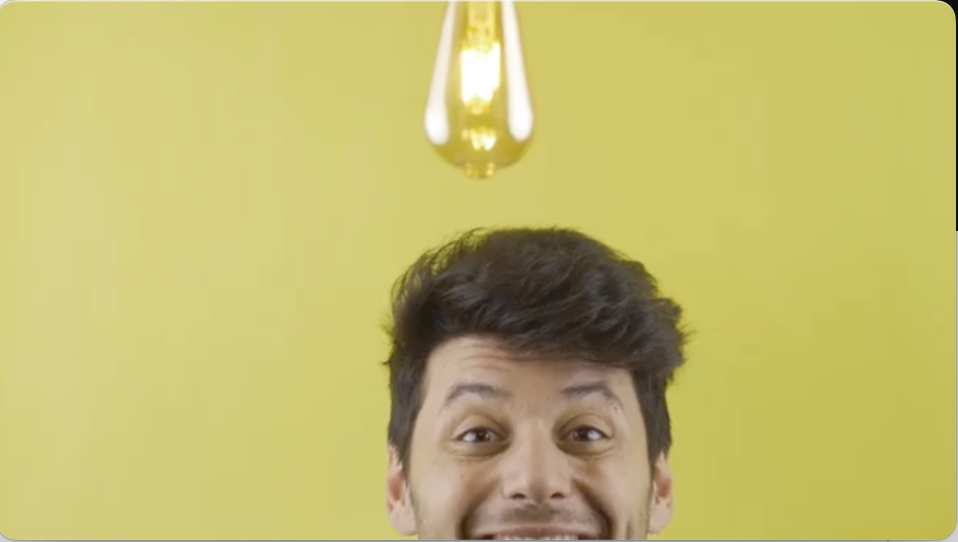
In my treatise, « 50 Secrets of Magic Craftsmanship », I unveiled secret number 3, a ritual aptly named “Slumber with a Key.” Seated with a key in hand above an overturned plate, let sleep gently overtake you. The key’s fall and resulting tinkling awaken you to a state of heightened inspiration. Such “Creative Naps” have been the crucible of my own artistic triumphs. – Salvador Dalí
Recently, a team of French neuroscientists validated the “Creative Nap” method which is associated with hypnagogia, an unique state of consciousness between wakefulness and sleep characterized by fluid idea association. Their results, published in the journal Science Advances, show that a “Creative Nap” helped to solve math riddles, with a 300% increase!
EurekIA™ offers creators worldwide an “Idea Catcher”, a physical device in the form of a stylish egg, which detects when the user falls asleep. As soon as sleep is detected, the user is awakened and can record their fleeting ideas, captured and converted into text via a dedicated mobile application and advanced software technologies including AI (patent pending). This allows artists to immortalize their creative ideas.
And then in complete privacy, since the transcription is done locally on the user’s phone.

Don’t let your next masterpiece fade into oblivion. Secure your creative flashes with the EurekIA™ “Idea Catcher”. Record, refine, create.
Easily and privately record then automatically transcribe in text your “eureka! moments” with the EurekIA™ “Idea Catcher” and its intuitive mobile application.
Commitment: Your data is not used to train AI models

The EurekIA™ Ideation Workshop (under construction), with the “Idea Catcher” as its first milestone, helps you refine, structure, develop and share your ideas from your “Eureka! moments” to successful creations, all in complete privacy.
The goal of the “Ideation Workshop” is to maintain, train and develop your natural creativity in synergy with artificial intelligence tools.
Create a masterpiece, from the inspiration of the “eureka! moment” to the success of your creative endeavor.
Turn your unique “Eureka! moments” into reality with tools designed for creators, by creators.
EurekIA™ is a creative tool based on neuroscience and advanced software technologies to capture your inspiration and provide tailored insights, helping you refine and develop your creative artworks more effectively.
EurekIA™ uses a mobile application and the EurekIA™ “Idea Catcher” device, inspired by the egg of Columbus, to record and transcribe to text your “Eureka!” or “Aha!” moments of inspiration that occur during “Creative Naps”.
The “Creative Nap” is an almost forgotten creativity technique, used by historical geniuses such as surrealist painter Salvador Dalí, inventor Thomas Edison and probably physicist Albert Einstein*. This creativity technique has recently been validated by neuroscientists.
Everyone’s brain is unique! While you may not possess Dalí’s brain nor his muse Gala, and thus can’t replicate Dalí’s exact brilliant inspiration, with EurekIA™ you can follow his exact creative protocol and multiply your “Eureka! moments” using the secret number 3, a ritual aptly named “Slumber with a Key.” unveiled by Dalí in his book “50 Secrets of Magic Craftsmanship“. Never again risk forgetting your own brain’s brilliant creative insights.
EurekIA™ is also a method that guides you with personalized information and exercises aimed at training and enhancing your creativity, always keeping the human at the heart of the creative process.
*Note: Einstein lost himself in creative daydreams and thought experiments akin to creative naps.
According to legend, “Eureka!” is the cry uttered by the Greek scientist Archimedes (-287, -212) when he understood the physical laws that govern objects immersed in a liquid (hydrostatic), while he was taking a bath, perhaps , maybe while napping or slightly asleep. “Eureka” is a Greek word meaning “I have found it”.
An “Eureka! moment”, also called an “Aha! moment”, is the instant when an idea emerges spontaneously and involuntarily from our thoughts, often when falling asleep (hypnagogia), during a nap, while dreaming, or during quiet activities such as walking, playing music or taking a shower.
“Eureka! moment” does not come out of nowhere. It most often results from a long period of reflection and sometimes even a genuine obsession with a problem or work of art, with periods of concentrated work, daydreaming, and contemplation where inspiration is nourished and solutions are found. Usually, the “eureka!” moment occurs during a quiet moment, after hard and concentrated work of analytical processing.
An “Eureka! moment” is not just divergent creativity, nor convergent creativity, but a combination of the two. It is a solution that is both “ready-made” and “adapted” to the problem, and not simply a “strange idea”, nor an “unusual combination” or what is called a bisociation – it is THE SOLUTION.
Many artistic creations and masterpieces are the result of “eureka moments!”.
Author Mary Shelley (1797, 1851) dreamed up her novel Frankenstein, obsessed with the idea of resurrecting the dead, after the death of her child.
In his book “50 Secrets of Magic Craftsmanship“, the surrealist painter Salvador Dalí (1904, 1989) offered advice to aspiring painters. His secret number 3 described a method for taking short “Creative Naps” of about a second that consisted of sitting down, holding a key in your hand and placing a plate underneath. Once asleep, the key would fall into the plate and the resulting jingle would ensure immediate awakening. A silent video about Dalí’s book by the Dalí Museum and another video in English that describes the method “Sleeping with a Key”.
In a 2024 podcast, Paul McCartney (1942) of the Beatles revealed that the song ‘Yesterday’ came to him in a dream.
Read the ‘List of works based on dreams‘ in Wikipedia.
Creativity is essential for solving difficult problems, producing masterpieces, making scientific discoveries, carrying out complex projects, and designing objects and works of art. We simply cannot do without creativity.
First, let’s define creativity
According to scientific consensus, creativity (C) is the ability to produce or achieve something new and original (N), while being adapted to the problem or context at hand, called that effectiveness (E).
Giving this simple equation:
C = N x E
What is the difference between creativity and imagination?
Creativity and imagination are closely related, but they are not the same thing. Creativity is the act of creating something new in the real world, while imagination deals with thoughts that are free from the constraints of reality. In science and engineering, creativity predominates, while in art, imagination is king.
For convenience, we will assume a misnomer by using the word creativity instead of imagination, even in an artistic context.
A “Creative nap” isn’t truly a nap but rather a semi-conscious state called hypnagogia which corresponds to a state of slow-wave sleep called NREM Stage 1 a sleep state without rapid eye movements or non-rapid eye movements (NREM), which exists on the border between wakefulness and sleep. This state can last from a few seconds to several minutes as one gradually drifts into sleep.
During hypnagogia, both the focused and diffuse states of the brain coexist. This is precisely the state where “Eureka! moments” or “Aha! moments” often occur.
Dalí, Edison, and probably Einstein shared a clever method: they would nap with an object in their hand. As they fell asleep, the object would slip from their hands and the sound of it falling to the floor would wake them up. It was at this precise moment that an idea often surfaced, sometimes turning out to be a brilliant “eureka! moment”.
The “Creative Nap” is a “ritual” to multiply the “eureka! moments” but these can occur any time the brain is in default mode.
Now, how do you manage to fall asleep, just like that, in the middle of the day, when you’re not used to it? This is where a method like the 4-7-8 method of the physician Andrew Weil, comes in handy. Another technique, practiced among others by Thomas Edison, is partial sleep deprivation or polyphasic sleep (in several sessions or sleep cycles during the day) which allows you to fall asleep practically at will.
Attention! When faced with a new concept, it’s natural to try to associate it with something more familiar. But beware of shortcuts.
Many people take “power naps” of about 20 minutes and sometimes with a strong coffee to boost their energy and productivity, but those “power naps” are not “Creative naps”. “Creative naps” are very short, lasting only a few seconds or minutes, and do not involve any stimulants.
A better analogy for a “Creative nap” would be those moments when you wake up in the morning with the solution to a problem, or when an idea comes to you while napping, daydreaming, walking in the woods, listening to or playing music, or taking a shower, etc.
Defining Creativity
According to the scientific consensus, creativity is the ability to produce or achieve something that is both new and original, while also being adapted to the problem or context at hand.
According to Margaret Boden [1], a cognitive scientist (University of Sussex), there are three types of creativity:
1-Combinatory creativity makes new combinations of familiar ideas;
2-Exploratory creativity makes new ideas by exploring “conceptual spaces” that can be styles in art or theories in science, in particular their content, limitations and potential. In short, conceptual spaces represent culturally accepted methods for accomplishing tasks within a specific domain;
3-Transformational creativity consists of producing ideas that go beyond existing styles or theories to create new, completely original ones. Transformational creativity is based on intuition and insight — in other words, “eureka! moments”
The history of science and art is punctuated by these famous “eureka! moments”, those moments of sudden illumination that have led to revolutionary discoveries, masterpieces and inventions. The term itself originates from the anecdote of Archimedes, who is said to have shouted “Eureka!” upon discovering the law of buoyancy.
These “eureka! moments” seem to arise spontaneously, often in connection with states of sleep or semi-consciousness, such as waking up, napping, daydreaming, falling asleep (hypnagogia), or even dreaming. The creative process involves a dynamic interplay between focused attention and mind-wandering, guided by a mechanism that identifies and chooses original and relevant ideas.
In his book “An Essay on the Psychology of Invention in the Mathematical Field.” [2], mathematician Jacques Hadamard explores the process of discovery-invention in mathematics by drawing on his personal experience and the testimonies of other great mathematicians including Henri Poincaré and the physicist Albert Einstein. Hadamard, who emphasizes the importance of intuition and the unconscious, describes four main phases in the process of discovery-invention:
1- Preparation: conscious and reflective phase where the creative person establishes relationships between his knowledge and the problem to be solved;
2- Incubation: period of unconscious work;
3- Illumination: “eureka! moment” of understanding or discovery;
4- Verification-finishing: phase of validation and conscious elaboration of the results.
Salvador Dalí [4], Thomas Edison [5] and probably Albert Einstein [6], aware of the importance of these moments of lucidity, shared a particular method to stimulate their creativity and capture their flashes of inspiration. They practiced what is called a “Creative nap”: a nap during which they held an object in their hand, which would fall and wake them up at the moment of falling asleep, often at the precise moment when brilliant idea emerged.
This almost forgotten technique has recently been validated by neuroscientists. In 2021, a team of French neuroscientists confirmed the effectiveness of the “Creative Nap,” demonstrating that it increased by 300% the number of people able to find a trick to solve a mathematical puzzle [3]. In neuroscience, it has been established that the state of hypnagogia, characterized by a semi-consciousness between wakefulness and sleep, is particularly helpful to creativity. It allows a free flow of thoughts and their associations, similar to that of dreams, while retaining enough consciousness to remember one’s thoughts. This is why a “Creative nap” of just a few seconds, halfway between wakefulness and sleep, can stimulate creativity.
The study “Sleep onset is a creative sweet spot” published on December 8, 2021, in Science Advances [3], shows the importance of these moments of rest in the creative process, thus offering a structured method to access inspiration and innovation. An article in Scientific American [5] discusses the French study, highlighting a period of increased creativity in the semi-lucid state just before falling asleep and evoking Thomas Edison’s nap technique.
Meanwhile, John Kounios, Ph.D., in a podcast from the American Psychological Association [7], explores these moments of sudden inspiration as an essential form of creative thinking, detailed in a book written with Mark Beeman “The Eureka Factor” [8]. The New Yorker, in an article [9], examines the research work of Mark Beeman on insight, a key element of creativity, shedding light on the neurological processes behind these moments of lucidity.
Finally, Christopher Dwyer of Psychology Today [7] critically analyzes “eureka! moments”, suggesting that they are less isolated moments of revelation and more the result of a continuous and evolving thought process.
Together, these studies offer a deeper understanding of creativity, highlighting the particular role of “Creative naps” in stimulating and exploiting “eureka! moments.”
This research continues and you could contribute…
Possibilities and limits: The study, “Sleep onset is a creative sweet spot,” [3] shows a 300% increase in problem-solving performance between those who attempted to solve problems after a “Creative nap” and those who did not take a “Creative nap” or fell into deep sleep. So this shows that “Creative naps” can promote creative ideas for solving problems.
The study “Sleep onset is a creative sweet spot” [3] shows a 300% increase in the performance of solving mathematical puzzles between those who attempted to solve these problems during a “Creative nap” and those who did not take a “Creative nap” or fell into a deep sleep [3]. This shows that the “Creative nap” promotes the production of effective ideas to solve problems.
To be honest, these are small “eureka! moments” compared to those of great geniuses like Dalí, Edison or Einstein. In fact, the importance of “eureka! moments” is linked to the individual’s abilities, their brain and the problems that are tackling. Unfortunately, taking “Creative naps” does not magically transform any individual into a genius. You cannot have Einstein’s ideas if you do not have Einstein’s brain, his knowledge in physics and his obsession with certain fundamental concepts like time, space and gravity.
The good news is that each of us, whether we are simple creatives or great geniuses, can benefit from and stimulate our natural creativity thanks to the “Creative nap”.
Finally, if Dalí [4], Edison [5] and probably Einstein [6], practiced “Creative naps”, it’s likely because they derived some benefit from them, for example to train their creativity or even just to avoid forgetting a fugitive brilliant idea!
The professions and jobs of creative individuals are very diverse. Creative individuals are people who bring something new to the world. There are many artists, researchers, inventors, engineers, designers and advertisers. However, creativity is not limited to these fields; it is also found in sectors such as entrepreneurship, agriculture, education, management and even the police, where investigators must be creative in their work.
The dominant psychological trait among creative people is curiosity, which can be defined as a desire for information for its own sake, a desire to know. A study entitled “A Meta-Analysis of the Relationship between Curiosity and Creativity” [11] showed that the more curious a person is, the more likely they are to be creative. This correlation underlines the importance of curiosity as a driver of creativity.
Conclusion
EurekIA™ stands out for its unique approach to creativity, by exploiting “eureka! moments” through the organized practice and habit of the “Creative naps”, moments of lucidity and sudden inspiration that have historically led to major discoveries, masterpieces and inventions.
EurekIA™ is designed to stimulate, multiply, harness, and above all, capture “eureka! moments” by placing people at the center of the creative process. This is achieved through the practice of the “Creative nap” using the “EurekIA™ Idea Catcher.”
Bibliography
[1] BODEN Margaret (2010), “Creativity and art: Three roads to surprise“. Oxford University Press.
[2] HADAMARD Jacques (1945). “An Essay on the Psychology of Invention in the Mathematical Field“. Princeton University Press.
[3] LACAUX Célia, ANDRILLON Thomas, BASTOUL Céleste, IDIR Yannis, FONTEIX-GALET Alexandrine, ARNULF Isabelle, & OUDIETTE Delphine (December 8, 2021). “Sleep onset is a creative sweet spot“. Science Advances, 7 (50).
[4] CARACCIO Mina, KRYGER Meir H. (2023). Salvador Dalí: Hypnagogic Hallucinations in Art. Sleep Health: Journal of the National Sleep Foundation, 9(1), 1-2.
[5] BRET Stetka (December 9, 2021). “Thomas Edison’s Naps Inspire a Way to Spark Your Own Creativity“, Scientific American.
[6] GORVETT Zaria (June 12, 2017). “What you can learn from Einstein’s quirky habits“, BBC.
[7] KOUNIOS John (August, 2021) “Speaking of Psychology: Creative Insight“, American Psychological Association.
[8] BEEMAN Mark, KOUNIOS John (2015) “The Eureka Factor: Aha Moments, Creative Insight, and the Brain“, Random House.
[9] KONNIKOVA Maria (May 27, 2014). “Where Do Eureka Moments Come From?” (May 27, 2014), The New Yorker.
[10] DWYER Christopher (August 5, 2021). “When Do Genuine ‘Eureka’ Moments Happen?”. Psychology Today
[11] SCHUTTE Nicola S., MALOUFF John M. (July 10, 2019). “A Meta-Analysis of the Relationship between Curiosity and Creativity”, The Journal of Creative Behavior, 54(4), 940-947.
First and foremost, you must be fully immersed or even obsessed with the work you want to create or the problem you need to solve. Otherwise, you risk getting distracted by your personal worries, social media, or latest news.
Preparing for a “Creative nap”
Once you are deeply focused on your problem, invention or work of art, find a quiet place and settle into a comfortable chair.
The entire “Creative nap” experience, from start to finish, should take less than ten minutes. While those who are used to napping may fall asleep in less than five minutes, give yourself plenty of time—up to an hour in total for your first few “Creative Naps”.
You need time to calm your mind, forget about distractions like social media, and let go of everyday worries. Following the advice of the famous British actor and former Monty Python member John Cleese*, the key is to simply sit and wait patiently, even in the midst the initial flood of thoughts and mild anxiety. Give your mind time it needs to calm down, and it will eventually find stillness.
To fall asleep, you need to free your mind from distractions and emergencies. It’s human nature to get caught up in trivialities, neglecting important tasks that require deeper thought. We often prefer the comfort of small, familiar tasks, like social media interactions, to the uncertainty of larger projects.
Now, if you’re not used to napping, how do you fall asleep in the middle of the day? This is where a method like the 4-7-8 method by physician Andrew Weil can come in handy. Another technique, practiced by Edison, among others, is partial sleep deprivation or the practice of polyphasic sleep (in several sessions or sleep cycles) which allows you to fall asleep practically at will. In short, the night before your first creative nap, you should have a short night.
Sleepiness detection
When falling asleep, due to muscle relaxation, the hand holding the “Idea Catcher” opens slightly and it falls to the ground.
When the “Idea Catcher” touches the ground, the tinkling sound of the bell it contains will be detected by the EurekIA™ mobile application. In effect, thanks to deep learning, the EurekIA™ mobile application can identify the characteristic tinkling sound of a bell, a jingle bell, or a spoon hitting a plate. This will prevent the mobile application from waking you up because of ambient noise or a conversation.
Instructions:
1- Hold your smartphone in one hand or place it nearby.
2- Launch the EurekIA™ mobile app on your smartphone.
3- Tap the large round “INITIATE A CREATIVE NAP” button.
4- A sound signal will indicate that the “Idea Catcher” is ready and waiting for you to fall asleep.
5- In your free hand, hold the small end of the “Idea Catcher,” which is the tip of the “EurekIA™ Egg.” Your fingers should be just close enough to prevent the “Idea Catcher” from falling to the floor. The goal is for muscle relaxation to cause the “Idea Catcher” to fall when you fall asleep.
6- Once the alarm sounds, the EurekIA™ mobile app will record everything you say. Thus, EurekIA™ minimizes friction and prevents you from losing your precious “eureka moment!”
7- In the Pro version of the mobile app, the transcription of your ideas from audio to text format is performed automatically by your phone’s native software and hardware.
Transcribing your ideas into text allows you to analyze your ideas, organize them, visualize them, share them, combine them, enrich them, and transform them into action plans in the “EurekIA™ Ideation Workshop” (in development).
*Note: John Cleese did not take “Creative Naps”, but rather practiced “Creative daydreaming” sessions in a calm environment that encouraged creative expression.
EurekIA™ is designed for creative professionals, artists, designers, painters, writers, musicians, filmmakers, etc. In fact, anyone looking to boost their creativity and capture spontaneous ideas can benefit from our tools.
Using an “Idea Catcher” is part of adopting a new habit, the ritual of the “Creative Nap.” Additionally, placed in your art work environment, the cute EurekIA™ “Idea Catcher” egg serves as a reminder to more easily create the habit of “Creative Naps.”
High-level creatives will be able to tap into their natural “eureka!” moments. Despite all the hype, it is unlikely that a generative AI tool will be able to compete with these moments of pure human genius any time soon.
Congratulations, you are very creative! This is precisely why EurekIA™ was designed for you, to stimulate and better exploit your natural creativity.
This explains why surrealist painter Salvador Dalí, inventor Thomas Edison and probably physicist Albert Einstein practiced the ritual of the “Creative nap”. Honestly, do you think these renowned geniuses took “Creative naps” because they lacked imagination?
Just like athletes train their bodies to perform, great creatives train their minds to be more creative.
That said, no one is forcing you to do anything. Either you train your creativity with scientifically proven methods like the “Creative Nap” and tools like the EurekIA™ “Idea Catchers”, or you let chance decide, at the risk of not realizing your full creative potential. You can also rest on your creative laurels and let less creative individuals catch up with you using generative AI crutches. It’s up to you…
Finally, maybe you’re hesitant to buy a new product? No problem, you can try the Discovery version of the EurekIA™ mobile application which is free.
Let us recall that EurekIA™ aims to stimulate, multiply, and harness ‘eureka! moments’—which represent the pinnacle of human creativity—placing creative people at the center of the creative process.
The proliferation of generative AI tools including generative chatbots, such as ChatGPT, Claude, Gemini, LLaMa, DeepSeek, etc., and text-to-image generation tools, such as Dall-E, Imagen, Midjourney, Stable Diffusion, etc., are provoking lively debates in creative communities and among scientists around intellectual property and their creative potential.
Generative AI is most useful to low creative people
Scientific studies have shown that generative AI tools can help low performers outperform average performers [1], [2], [3], [4].
“The main beneficiaries of AI use are subjects with below-average skills.” [3], [4]
“Inequality among workers decreases because ChatGPT narrows the productivity distribution, benefiting low-skilled workers more.” [1]
“The weakest students in the class saw huge performance gains with the help of AI, while the best students in the class saw their performance decline.” [2]
On the creative side, improvements are particularly evident in divergent creativity tasks such as brainstorming.
Generative AI is comprehensive but not very original
Typically, generative AI tools create in the same style as their training data* and are limited to combinatorial creativity and perhaps exploratory creativity but not transformational creativity [3].
“ChatGPT narrows the range of ideas that subjects generate on average” [3]
“Furthermore, ChatGPT was better at generating incremental rather than radical new ideas” [5]
Generative AI is thus still very far from reproducing the “eureka! moments” of highly creative people and transformational creativity, which combine both divergent and convergent creativity with a visceral desire to arrive at the best solution or create a masterpiece.
* Note: Technically within the statistical distribution of their training data.
It’s mathematically proven: current generative AI will never be able to match human creativity.
A scientific study published in The Journal of Creative Behavior [11], mathematically demonstrates the creative limitations of current large language models (LLMs). For some time, seemingly contradictory studies had shown either that generative AI was less creative than humans or that humans were more creative than generative AI.
David H. Cropley, a researcher specializing in creativity in engineering at the School of Engineering, University of South Australia, reconciled these studies by showing that while generative AI is often more creative than the average untrained human (amateur creative), its creativity plateaus, and highly trained and creative humans (professional creatives) demonstrate greater creativity than generative AI. This limit, determined by the algorithms of generative AI, corresponds to the boundary between amateur creativity and true creativity.
Dr Cropley demonstrates the creativity limits for current standard LLM architectures, on which the GAFAM+ companies are putting all their efforts. This says nothing about the creativity of future AI algorithms using other approaches.
The abuse of generative AI represents a risk for your natural creativity
Recent scientific studies warn of the risk that intensive use of generative AI tools poses to our creative abilities [1]. Indeed, neuroscience is clear on this: we become what we do with our brains. The brain is affected by how we use it. It is not a stretch to expect that intensive use of digital tools will change the human brain due to neuroplasticity. And like muscles that atrophy, our natural ability to feel inspired/creative may be harder to tap into the less we use it.
“Nearly three out of four participants told researchers they were concerned that using ChatGPT would cause their own creative muscles to atrophy. » [4] – François CANDELON of the Boston Consulting Group
Asking an AI tool to generate ideas, write a text or solve a problem for us may be convenient, but it short-circuits our brain, bypassing the neural circuits that accompany the mastery of mental processes involved in creativity, problem solving or writing texts. Only we can create and strengthen our neural connections, and this only through our own intellectual work.
For example, it has been shown that “intensive” use of GPS reduces the number of neurons and connections in our hippocampus leading to hippocampal atrophy [6]. Conversely, this explains why London taxi drivers have an overdeveloped hippocampus, because to pass the driver’s exam, they must know London by heart [7].
Neuroscience researchers have used magnetic resonance imaging to observe changes in the brains of adults learning to juggle. After three months of training, some areas of the brain responsible for processing complex movements had thickened. However, after another three months without practice, these changes in the brain had disappeared. This study shows that learning physically changes the brain and that, like a muscle, if we do not use these new connections, they weaken. This is proof that for the neural networks in our brain, it is “use them or lose them!” [8], [9].
“So this supports the famous « use it or loose it » about neural connections and learning” [8] – Bruno DUBUC, neurobiologist
Neuroscience is clear on this subject. The development and maintenance of complex cognitive abilities requires active work and cannot rely solely on technological assistance.
A recent Swiss study shows a significant negative correlation between the frequent use of generative AI tools and critical thinking abilities, facilitated by increased cognitive offloading [10]. Younger participants in this study showed greater reliance on AI tools and lower critical thinking scores than older participants [10].
Although the cause and effect relationship is not yet established with certainty, a growing body of research suggests that addiction to these tools could lead to widespread cognitive decline and probably create a generation of cognitively assisted people, subscribed for life to generative AI tools.
In the long term, the intensive use of generative AI tools and the law of least effort risk creating a generation of “cognitively assisted” people, subscribed for life to generative AI tools.
A picture is worth a thousand words, an advertisement from Apple Intelligence [11] that humorously illustrates the risk of abusing the use of generative AI tools.
Intellectual Property Issue
The tech companies that produce generative AI tools insist that their models must be trained on all the world’s intellectual property raked across the web in order to work properly, but these companies have paid little to no compensation to the artists, writers, and others who created that intellectual property.
There is an ethical problem when generative AI tools can potentially replace artists and their livelihoods on an industrial scale. Worse, adding insult to injury by using the works of these artists raked across the web to train generative models. This is why many artists, authors and book publishers including the New York Times have filed lawsuits for copyright infringement.
The environmental footprint of generative AI is considerable
Generative AI has a considerable environmental impact in terms of electricity consumption, greenhouse gas emissions and water consumption.
For example, a generative search engine uses “30 times more energy” than a traditional search engine, warns researcher Sasha Luccioni, who is studying the environmental impact of this new technology. Also, producing a high-definition image using a text-to-image generation tool consumes as much energy as fully recharging your cell phone battery.
In the long term, will AI systems be more creative than human beings?
If we are materialists, there is no reason to believe that an AI system cannot be as creative, or even more creative than a human being, at least in the long term.
On the other hand, the extreme complexity of a brain and its multiple connections, sub-networks and reinforcement/inhibition mechanisms are an asset that an AI system lacks, even though it has read every text on the web and digital books… For example, the architecture of large language models (LLMs) is incomparably simpler than a cat’s brain.
The best current generative AI systems—not future, more advanced systems or science fiction ones—barely reach the divergent creativity of an amateur creative and don’t even appear on the radar for convergent creativity. Since we’re discussing current systems, not hypothetical future ones, it would be best to maintain a degree of skepticism and a great deal of scientific humility.
Even if AI systems become more creative than humans, all in all, human beings are not going to give up their creativity, nor their ability to solve problems or write texts on their own. It’s much like we don’t give up playing chess, lifting weights, or running just because machines can do it better.
Maintain, train and develop your natural creativity in synergy with AI
The goal of the “EurekIA™ Ideation Workshop” (under construction) is to maintain, train and develop your natural creativity in synergy with artificial intelligence tools, not to replace it.
The idea is not to oppose AI but rather to choose the right tools and use them wisely by putting the human at the heart of the creative process, which involves capturing your “eureka! moments”.
Conclusion: Used in moderation, generative AI is synergistic with EurekIA™
Based on science and in a pragmatic spirit, the EurekIA™ team recommends choosing the best tool adapted to each work to be carried out while respecting copyright and the cognitive faculties of its users. For example, generative AI can be useful to counter blank page syndrome, rephrase text, generate comprehensive list of usual ideas, or generate the draft of a text in a foreign language that will be revised by a professional translator.
It is the dose that makes the poison and also the duration of exposure. AI tools used in moderation are undoubtedly a good thing, it is the excess and the long-term effects that are worrying.
Complementary to generative AI, EurekIA™ centers the creative process on humans while allowing responsible and ethical use of advanced software technologies including AI tools.
Bibliography
[1] NOY S. & ZHANG W. (March 2, 2023) “Experimental Evidence on the Productivity Effects of Generative Artificial Intelligence“, MIT, Working Paper
[2] CHOI J.H. & SCHWARCZ D. (August 13, 2023)) “AI Assistance in Legal Analysis: An Empirical Study“, University of Minnesota Law School Legal Studies, Research Paper Series
[3] LAKHANI K. & al (September 22, 2023) “Navigating the Jagged Technological Frontier: Field Experimental Evidence of the Effects of AI on Knowledge Worker Productivity and Quality“, Harvard Business School Technology & Operations Mgt., Unit Working Paper, (24-013).
[4] BERREBY D. (December 28, 2023). “ChatGPT Helps, and Worries, Business Consultants, Study Finds“, New-York Times.
[5] LEE, B. C., & CHUNG, J. (August 12, 2024). “An empirical investigation of the impact of ChatGPT on creativity“. Nature Human Behaviour, 1-9.
[6] BIRKEL, Lindy, (September 2017). “Decreased use of spatial pattern separation in contemporary lifestyles may contribute to hippocampal atrophy and diminish mental health” Medical Hypotheses, 2017, vol. 107, p. 55-63.
[7] JABR, Ferris (December 8, 2011). “Cache Cab: Taxi Drivers’ Brains Grow to Navigate London’s Streets“, Scientific American.
[8] DUBUC, Bruno (2024) “Notre cerveau à tous les niveaux – Du Big Bang à la conscience sociale”, Écosociété, 2024.
[9] DRAGANSKY, B., GASER, C., BUSCH, V., SCHUIERER, G., BOGDAHN, U., MAY, A. (2004). Nature, 427(6972), 311-312. “Neuroplasticity: Changes in grey matter induced by training”. Nature, 427(6972), 311-312
[10] GERLICH, M. (2025). “AI Tools in Society: Impacts on Cognitive Offloading and the Future of Critical Thinking“. Societies, 15(1), 6.
[11] CROPLEY, David H. (2025). “The Cat Sat on the …?” Why Generative AI Has Limited Creativity, The Journal of Creative Behavior » Vol. 59, 4.
EurekIA™ offers creative people around the world a physical device, the “Idea Catcher”, and a companion mobile application, that together detect the hypnagogic state (between wakefulness and sleep) and capture ideas emerging during “Creative nap” experiences.
When falling asleep, the user drops the EurekIA™ “Idea Catcher” to the ground. The fall is detected, the user is awakened and then vocally records creative ideas and can convert them into text, with a minimum of friction and without the risk of losing precious “eureka! moments”.
The dedicated mobile application (Android or iOS) is based on advanced software technologies including sound recognition and transcription based on deep learning (patent pending).
The EurekIA™ egg
Echoing the legend of the “egg of Columbus” with its truncated tip and Dalí’s fascination with ovoid shapes, the “EurekIA™ egg” serves as a symbolic object. Beyond its aesthetic appeal and harmonious shape, the egg represents the beginning of a life—a seed of a creative adventure—and embodies the concept that “everything begins with an idea.”
Using an “Idea Catcher” is part of a ritual process, the ritual of the “Creative nap”. In addition, placed in your work environment, the EurekIA™ egg serves as a reminder to more easily create the habit of the “Creative nap”.
The size of the EurekIA™ egg is carefully designed to prevent it from getting stuck in your hand while still being large enough to hold a tiny bell and even become a fetish object. Its conical shape, reminiscent of a pear-shaped egg, is inspired by the egg of the Razorbill (Alca torda) that nests on the rocky cliffs of the Lower St. Lawrence Islands in Québec. This conical shape ensures that the egg, when pushed, will turn on itself rather than rolling towards the sea.
Finally, on a more personal note, the egg is an inspiring idea of Alice, the eldest daughter of Claude Coulombe, the founder of EurekIA™.
You can initiate a “Creative nap” in just a few minutes. The EurekIA™ “Idea Catcher” and its mobile software companion are user-friendly.
In addition, our tips on practicing the “Creative Nap” will allow you to easily integrate this innovative practice into your creative process or daily routine without any technical difficulties.
Your ideas are valuable and unique. The EurekIA™ team prioritizes the security of your data, so all the process including sleep detection and voice-to-text transcription are embedded on your phone. No cloud, no server communication.
The « EurekIA™ Ideation Workshop » (under construction) will use strong encryption and security measures to ensure that your ideas and personal information are protected.
As a first step, we commit to not disclosing, viewing, or training AI models with your data. We also commit to quickly establishing a Data Trust in a sovereign Canadian or European-owned cloud infrastructure for users who subscribe to the “EurekIA Ideation Workshop™” (under construction).
The short-term mission of EurekIA™ is to « Harness the creative power of “eureka! moments” by placing humans at the center of the creative process through the “Creative Nap” assisted by the “Idea Catcher” ».
In the longer term, EurekIA™’s mission is « Maintain, train and develop human cognition through neuroscience and artificial intelligence ».
The pursuit of our mission is largely achieved through applied research. In line with this mission, EurekIA™ is setting up a citizen science program.
In this way, you will contribute to scientific research and become an actor in future discoveries!
Join our citizen science projects and help us discover how people create, their “eureka moments!”, their creative process, their interest in techniques such as the “Creative Nap” and tools such as the EurekIA™ “Idea Sensor”.
More information to come…
Based in Montréal, a city known for its creativity and its research ecosystem in neuroscience and advanced software technologies, EurekIA™ is the latest technological venture of a seasoned team of scientists, creatives and serial entrepreneurs.
Our short term goal is to stimulate, multiply, and harness the creative power of “Eureka! moments”, placing the human at the center of the creative process. In the longer term, our quest is to contribute to the maintenance, training and development of human cognition.
The different versions of EurekIA™
EurekIA™ is available in several versions including a free version, a professional version and a business version. Each level offers different features and benefits to meet your creativity needs.
1- EurekIA™ Discovery mobile application – free:
EurekIA™ Discovery is a freeware that allows you to learn the technique of the “Creative nap” without spending a penny.
The EurekIA™ mobile application can be downloaded for free on the Google Play site for Android phones or on the Apple Store for iPhone / iOS.
With the Discovery version of EurekIA™, as an “Idea Catcher”, you can use a spoon and a plate like Dalí, a bell, a jingle bell, a set of keys, etc. The EurekIA™ mobile app will detect when you are falling asleep by identifying the characteristic tinkling sound of these objects when they hit the ground.
EurekIA™ Discovery is a limited/restricted* version that offers an option to unlock to the EurekIA Pro version.
*: A single audio recording file of up to two minutes. No transcription.
2- EurekIA™ Pro mobile app – $4.99 CAD or $2.99 USD:
The EurekIA™ Pro version of the mobile app offers unlimited audio recordings with no time limit (as long as there is space on your phone).
EurekIA™ Pro also allows you to transcribe your ideas (audio to text) with your mobile phone’s software and hardware.
3- “Idea Catcher” the EurekIA™ egg with bell – $41.99 CAD or $29.99 USD
To ritualize your creative naps, get yourself a EurekIA™ “Idea Catcher” in the form of a stylish egg with its symbolic truncated end and an integrated bell. Beyond its aesthetic appeal and harmonious shape, the EurekIA™ Egg represents the beginning, the seed of a creative adventure, embodying the fact that “Everything starts with an idea!”.
The use of an “Idea Catcher” is part of a ritual approach, the ritual of the “Creative nap”. In addition, placed in your work environment, the EurekIA™ Egg serves as a reminder to more easily create the habit of the “Creative nap”.
4- EurekIA™ Ideation Workshop (in development) – $6.99 CAD or $4.99 USD per month
To share, improve, merge, search, visualize your ideas and train your creativity, you can access the “EurekIA™ Ideation Workshop” (in development) with a convenient monthly subscription plan.
This feature will be configurable in a future version of the EurekIA™ Pro mobile app.
5- EurekIA™ Enterprise Application
This version is designed for value-added partners and distributors who will use it for training activities or to support creativity in business.
For more information, please contact us: info@eurekia.com
Getting started with EurekIA™ is easy. Simply download the app, connect the “EurekIA™ Egg Idea Catcher” device, and begin capturing and developing your “Eureka! moments”. Visit our website for more detailed instructions and support.